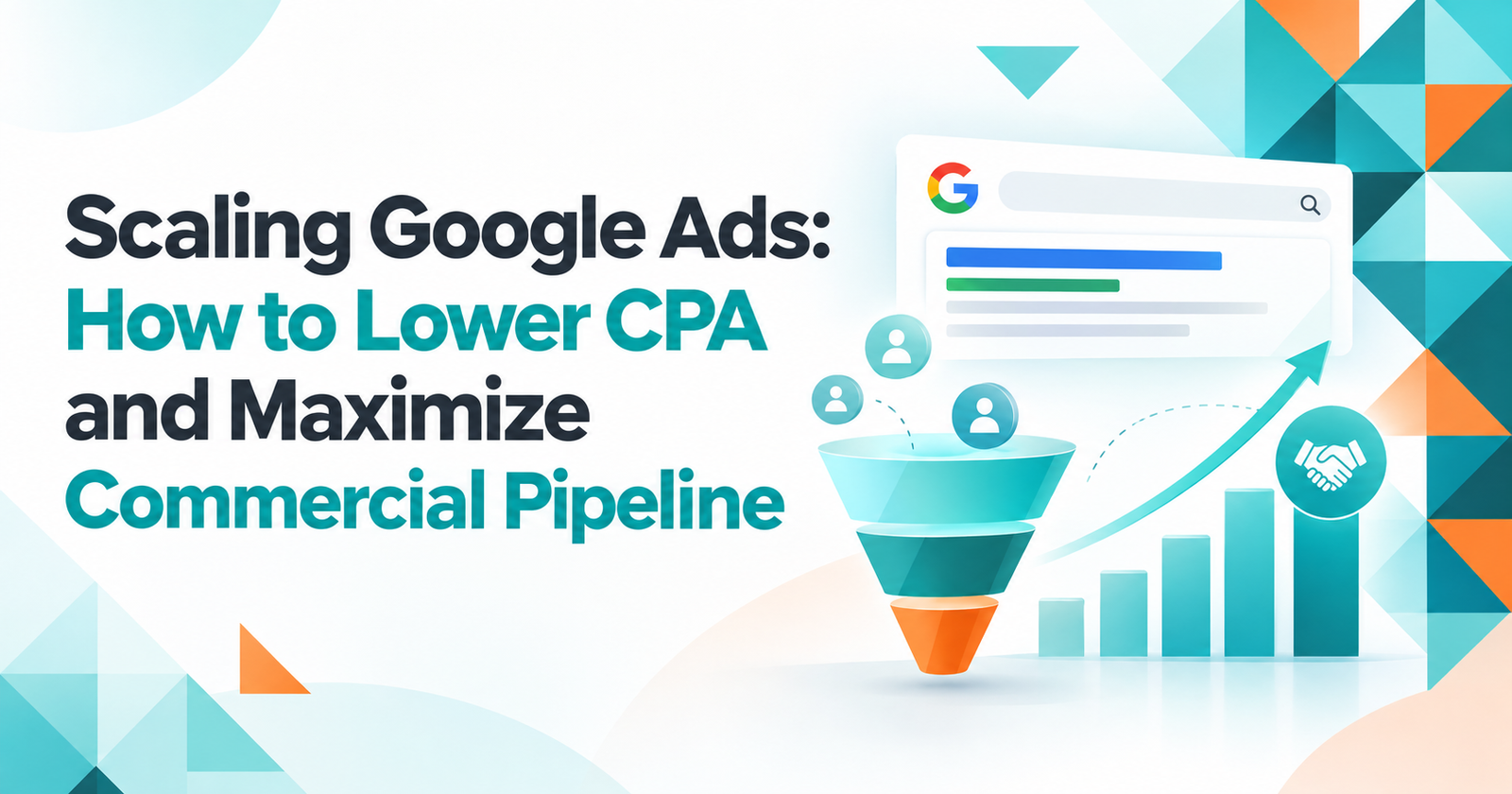
Scaling Google Ads: How to Lower CPA and Maximize Commercial Pipeline
Scaling Google Ads sounds simple.
Increase the budget, generate more clicks and produce more leads.
In practice, that approach often increases cost faster than revenue.
As campaigns expand, businesses can experience rising cost per acquisition, weaker lead quality, irrelevant search traffic and more enquiries that never turn into real sales opportunities.
The goal should therefore not be to spend more.
The goal should be to scale profitable demand while keeping acquisition efficiency under control.
That requires better conversion tracking, stronger campaign structure, tighter search intent, better landing pages and a clear connection between Google Ads and the commercial pipeline.
What Does Scaling Google Ads Actually Mean?
Scaling Google Ads means increasing the amount of valuable business generated from your campaigns without allowing efficiency to deteriorate beyond an acceptable level.
That may mean generating:
- More qualified leads
- More sales opportunities
- Higher-value customers
- More revenue
- More conversion value
while maintaining a sustainable:
- Cost per acquisition
- Cost per qualified lead
- Cost per opportunity
- Return on ad spend
A campaign generating 100 cheap leads is not necessarily better than one producing 40 qualified opportunities.
This is why businesses should look beyond headline CPA.
CPA Is Useful, but It Does Not Tell the Whole Story
The basic CPA calculation is:
If you spend $10,000 and generate 100 leads:
That looks easy to measure.
But what happens if only five of those leads are commercially useful?
Your true cost per qualified lead is:
Now consider another campaign spending $10,000 that generates only 50 leads, but 20 become qualified opportunities.
Its form-submission CPA is higher.
Its commercial performance is significantly better.
This is why Google Ads should eventually be optimised towards meaningful business outcomes rather than simply generating the cheapest possible conversion.
1. Fix Conversion Tracking Before You Scale
Do not increase budget until you trust your conversion data.
Google Ads bidding systems use conversion data to decide which auctions are more likely to produce results.
If weak actions are counted as primary conversions, campaigns may start optimising towards the wrong behaviour.
For example, avoid treating actions such as these as equally valuable:
- Page views
- Button clicks
- Form starts
- Form submissions
- Qualified leads
- Booked appointments
- Completed sales
Your primary conversion actions should reflect genuine business value.
For lead-generation businesses, this often means connecting Google Ads with your CRM so later-stage outcomes can be sent back into the advertising platform.
2. Track Qualified Leads, Not Just Form Submissions
Many lead-generation campaigns struggle because Google Ads knows who submitted a form but does not know what happened afterwards.
The platform may see two enquiries as identical.
Your sales team may know that one became a $20,000 opportunity and the other was completely irrelevant.
That information matters.
A better tracking structure may include:
Lead
Someone submits an enquiry.
Qualified Lead
The enquiry meets your business criteria.
Opportunity
The prospect enters a genuine sales process.
Customer
Revenue is generated.
Connecting these outcomes back to Google Ads gives bidding systems stronger signals about the type of users your business actually wants.
Enhanced conversions for leads and CRM-based conversion imports can help connect online ad interactions with later offline outcomes.
3. Choose a Bidding Strategy Based on the Business Goal
There is no single best bidding strategy for every campaign.
Google Ads offers Smart Bidding strategies including:
- Maximise Conversions
- Target CPA
- Maximise Conversion Value
- Target ROAS
The correct choice depends on what your business wants to optimise.
Maximise Conversions
This can be suitable when your main objective is generating the highest possible conversion volume within your available budget.
Target CPA
Target CPA aims to generate conversions around a desired average acquisition cost.
This can help when conversion volume matters and different conversions have broadly similar business value.
However, an unrealistically low CPA target can limit the auctions your campaign is willing to enter.
Maximise Conversion Value
This becomes more useful when different conversions have different commercial values.
Instead of treating every lead equally, campaigns can optimise towards greater total value.
Target ROAS
Target ROAS is more appropriate when reliable conversion values are available and the goal is to generate value while working towards a defined return.
For businesses with different service values, customer values or lead quality levels, value-based bidding can become more useful than simply chasing the lowest CPA.
4. Improve Search Intent Before Increasing Budget
Scaling irrelevant traffic simply creates more expensive waste.
Before expanding spend, review the actual searches triggering your ads.
The search terms report can reveal:
- Irrelevant searches
- Research-only searches
- Job seekers
- DIY intent
- Free-service searches
- Competitor searches
- Low-value service terms
- Unexpected high-intent searches
Use this information to improve your keyword strategy and negative keyword lists.
Negative keywords can prevent ads from appearing for searches that are unlikely to generate customers.
At the same time, do not automatically block every query that has not converted after a small number of clicks.
Look at patterns, intent and enough data before making decisions.
5. Improve Ad Relevance
Google Ads performance is heavily influenced by the relationship between:
If someone searches:
commercial lawyer Melbourne
and sees a generic ad saying:
Professional Business Services
the message is weak.
A stronger ad should closely match the user's intent.
Responsive Search Ads should contain useful variations covering:
- Main service
- Location
- Commercial benefit
- Trust signal
- Problem being solved
- Call to action
Avoid simply repeating the same headline fifteen times with minor wording changes.
Provide distinct assets that allow Google to test meaningful combinations.
6. Do Not Ignore the Landing Page
You cannot fix a poor landing page by continually increasing the Google Ads budget.
If users click an ad and reach a page that is slow, confusing or irrelevant, conversion rates can suffer.
Google considers landing page experience as one component used in its Quality Score diagnostic.
A strong landing page should provide:
- Clear headline
- Strong message match with the ad
- Relevant service information
- Trust signals
- Simple navigation
- Clear CTA
- Mobile-friendly design
- Fast loading
- Easy enquiry process
For example, an ad promoting:
Google Ads Management Melbourne
should ideally send users to a relevant Google Ads service page rather than a generic homepage.
7. Improve Conversion Rate Before Buying More Traffic
Suppose your campaign receives 1,000 visitors.
At a 3% conversion rate:
If you improve the landing page conversion rate to 5%:
That is 20 additional conversions from the same amount of traffic.
Improving conversion performance can therefore create more scale without immediately paying for more clicks.
Test areas such as:
- Headlines
- Calls to action
- Forms
- Mobile layout
- Trust signals
- Testimonials
- Offer clarity
- Page speed
- Service explanation
Google Ads optimisation should not stop once someone clicks the advertisement.
8. Separate Lead Volume From Lead Quality
One of the most common mistakes in lead-generation campaigns is celebrating a falling CPA without checking sales quality.
Imagine:
Campaign A
CPA: $60
Qualified lead rate: 10%
Campaign B
CPA: $100
Qualified lead rate: 40%
Campaign A looks cheaper in Google Ads.
Campaign B may create far more commercial value.
Track metrics such as:
- Cost per lead
- Cost per qualified lead
- Cost per opportunity
- Lead-to-opportunity rate
- Opportunity-to-sale rate
- Average customer value
- Pipeline generated
- Revenue generated
This gives management a much better view of whether scaling actually makes sense.
9. Scale Budget Where Marginal Spend Still Works
Not every campaign deserves additional budget.
Before increasing spend, identify campaigns that:
- Produce qualified leads
- Have reliable conversion tracking
- Generate commercial opportunities
- Have room to capture additional demand
- Maintain acceptable acquisition economics
Do not distribute extra budget equally across every campaign.
Invest where additional spend has a realistic chance of creating additional business value.
Google Ads Performance Planner can also model how changes to budgets and bidding targets may affect forecast performance.
Forecasts are estimates rather than guarantees, but they can help with planning.
10. Use Commercial Pipeline as the Final Measurement Layer
For B2B and high-value service businesses, Google Ads should eventually be connected to the sales pipeline.
Instead of reporting:
Google Ads generated 75 leads
report something closer to:
75 leads
28 qualified leads
14 opportunities
$180,000 pipeline value
6 customers
This changes the conversation.
Marketing is no longer judged only on click-through rate or form submissions.
It is evaluated based on its contribution to business growth.
A Better Google Ads Scaling Framework
A practical scaling process can follow this sequence.
Stage 1: Measurement
Confirm that primary conversions, enhanced conversions and CRM outcomes are being tracked correctly.
Stage 2: Traffic Quality
Review search terms, keywords, locations, devices and audience signals.
Remove obvious waste.
Stage 3: Creative Relevance
Improve Responsive Search Ads and assets so messaging matches customer intent.
Stage 4: Landing Page
Fix conversion problems before increasing traffic.
Stage 5: Lead Quality
Connect marketing conversions with CRM and sales outcomes.
Stage 6: Bidding
Choose Target CPA, Maximise Conversions or value-based bidding based on the data and commercial objective.
Stage 7: Budget Scaling
Increase investment in campaigns that demonstrate sustainable business value.
Stage 8: Pipeline Review
Measure qualified leads, opportunities, customer acquisition cost and revenue.
Then repeat the process.
Common Mistakes When Scaling Google Ads
Avoid these common errors:
- Increasing budget before fixing tracking
- Optimising only for cheap leads
- Using unrealistic CPA targets
- Ignoring search terms
- Sending every campaign to the homepage
- Counting low-value actions as primary conversions
- Ignoring sales feedback
- Making major campaign changes too frequently
- Scaling poor-performing campaigns because they have high impression volume
- Measuring marketing separately from the CRM
More activity does not automatically mean more growth.
How to Lower CPA Without Damaging Lead Quality
Lowering CPA should come from improving efficiency rather than simply chasing cheaper traffic.
Focus on:
- Better conversion tracking
- Stronger keyword intent
- Relevant negative keywords
- Better ad messaging
- Higher-converting landing pages
- Faster lead follow-up
- Better geographic targeting
- Stronger conversion signals
- Qualified lead tracking
- Value-based optimisation
The correct target is not always the lowest CPA.
It is the acquisition cost that produces profitable customers.
Scale Google Ads Around Commercial Outcomes
Google Ads can generate large volumes of traffic quickly.
That does not mean every account is ready to scale.
The strongest campaigns connect advertising data with what happens after the click.
They understand which searches create qualified leads, which leads create opportunities and which opportunities generate revenue.
That allows businesses to make better decisions about bids, budgets and campaign expansion.
If scaling increases spend but does not increase valuable pipeline, it is not effective scaling.
It is simply more advertising.
Need to Scale Your Google Ads More Profitably?
Melbourne Marketing Agency helps businesses improve Google Ads performance by connecting paid search with conversion tracking, landing pages, CRM data and commercial outcomes.
Our focus is not simply increasing clicks or lead volume.
We look at how Google Ads contributes to qualified enquiries, pipeline and measurable business growth.
Speak with Melbourne Marketing Agency about building a more scalable Google Ads strategy.
Frequently Asked Questions
How can I lower my CPA in Google Ads?
Improving search intent, negative keywords, ad relevance, landing page conversion rate and conversion tracking can help reduce wasted spend and improve acquisition efficiency.
Should I increase my Google Ads budget if CPA is good?
Not automatically. Check whether additional leads are qualified, whether campaigns have capacity to scale and whether customer acquisition economics remain sustainable.
What is a good CPA for Google Ads?
There is no universal good CPA. It depends on your profit margin, lead-to-sale rate, customer value and business model.
Is Target CPA better than Maximize Conversions?
Neither is always better. Maximize Conversions focuses on generating conversion volume within budget, while Target CPA introduces an average acquisition-cost objective.
What is value-based bidding?
Value-based bidding allows Google Ads to optimize towards conversion value rather than treating every conversion equally. It is useful when different leads, sales or customers have different commercial values.
How do I measure Google Ads pipeline?
Connect Google Ads with your CRM and track stages such as lead, qualified lead, opportunity and customer. This allows advertising performance to be evaluated against pipeline and revenue.