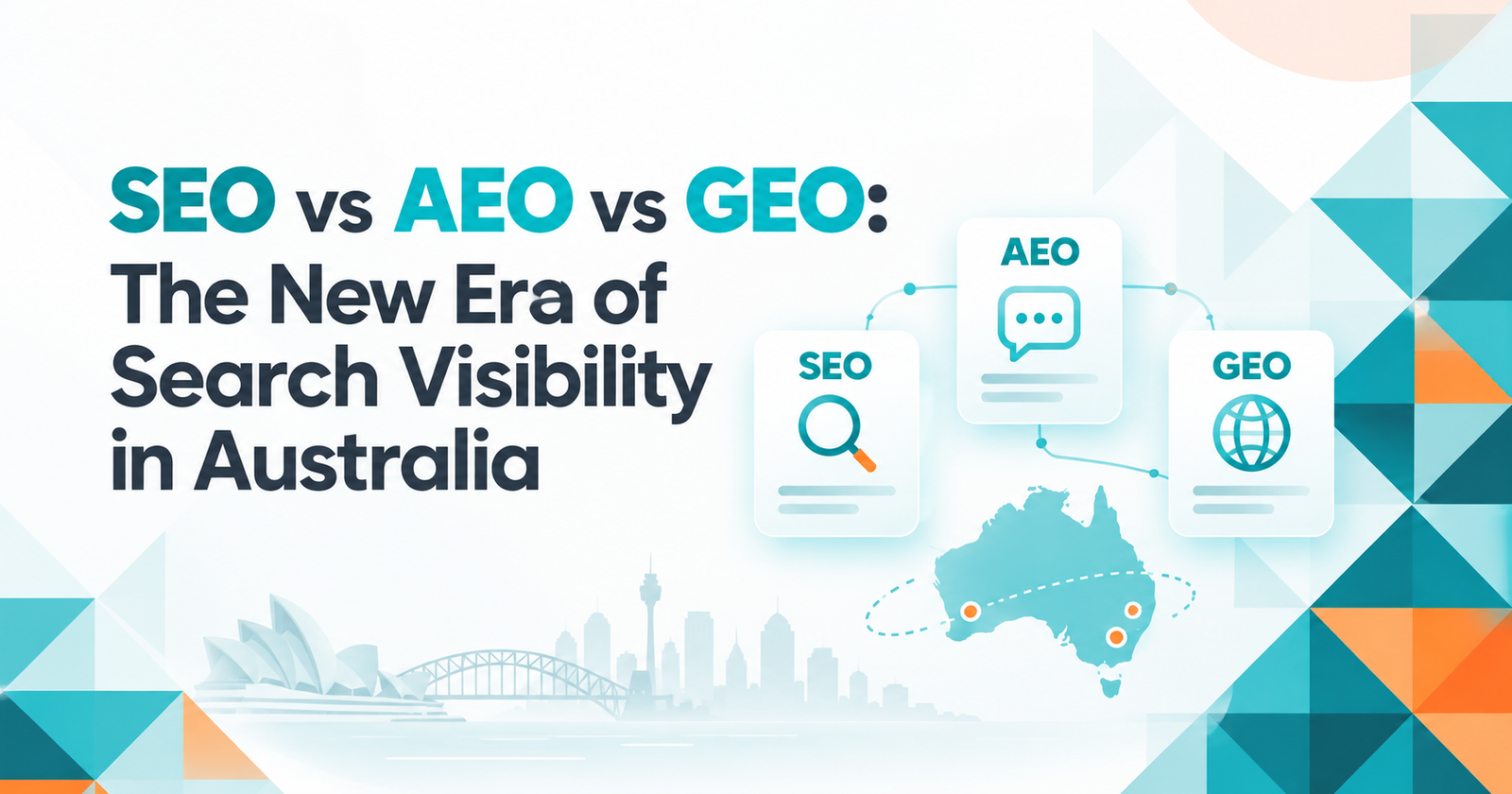
SEO vs AEO vs GEO: The New Era of Search Visibility in Australia
Search is changing.
For years, businesses focused mainly on one question:
That question still matters. But it is no longer the whole picture.
Searchers can now receive information through traditional Google results, featured answers, AI Overviews, conversational search experiences and AI assistants.
Google rolled out AI Overviews across Australia in October 2024, giving Australian users AI-generated summaries with links to supporting websites directly within Search.
As these experiences grow, three terms are appearing more often in digital marketing:
- SEO: Search Engine Optimisation
- AEO: Answer Engine Optimisation
- GEO: Generative Engine Optimisation
They overlap considerably, but each describes a slightly different visibility goal.
Understanding those differences can help Australian businesses prepare for how people are finding information now.
What Is SEO?
Search Engine Optimisation (SEO) is the process of improving a website so search engines can crawl, understand, index and rank its pages for relevant searches.
Traditional SEO focuses on areas such as:
- Keyword research
- Search intent
- Website structure
- Technical SEO
- Page speed and usability
- On-page optimisation
- Internal linking
- Local SEO
- Backlinks
- Helpful content
- Structured data
For example, a Melbourne accounting firm might optimise a page around:
A pest control company may target:
And a migration business might target:
SEO aims to make the most relevant page easier for search engines to understand and easier for potential customers to discover.
Is SEO Still Important in the Age of AI Search?
Yes.
Claims that AI search has made SEO obsolete are premature.
Google's current guidance says the foundations used for normal search continue to apply to generative AI experiences. Google recommends clear technical structure, valuable original content, good page experience and making sure pages can be crawled and indexed.
Without these foundations, AEO or GEO tactics have little to build on.
Think of SEO as the base layer.
AEO and GEO extend the way businesses think about how that information may be surfaced.
What Is AEO?
Answer Engine Optimisation (AEO) focuses on making information easy for search systems to understand and present as a direct answer to a user's question.
Instead of targeting only short keywords such as:
AEO also considers questions such as:
The goal is to provide clear, useful answers that search systems can easily interpret.
Common AEO Practices
A strong AEO strategy may include:
- Clear question-based headings
- Direct answers near relevant headings
- FAQ content where genuinely useful
- Well-structured service pages
- Strong entity information
- Relevant structured data
- Clear definitions
- Accurate business information
- Helpful comparison content
- Expert-led explanations
AEO does not mean writing hundreds of short FAQ pages.
The content still needs to provide real value.
What Is GEO?
Generative Engine Optimisation (GEO) generally refers to improving how a business or website may appear, be referenced or contribute information within AI-generated answers.
This includes experiences where an AI system synthesises information from multiple sources rather than simply displaying ten blue links.
Microsoft describes GEO as understanding how content participates in AI-driven experiences, including answers, citations and grounding. Bing Webmaster Tools introduced AI Performance reporting in 2026 to show publishers when their content is cited in supported AI answers.
GEO therefore raises a different question:
Instead of only asking:
businesses may also ask:
SEO vs AEO vs GEO: What's the Difference?
| Area | SEO | AEO | GEO |
|---|---|---|---|
| Main Goal | Rank and gain visibility in search results | Provide clear answers to questions | Improve visibility within AI-generated experiences |
| Focus | Pages, keywords and search intent | Questions and direct answers | Entities, expertise, citations and source usefulness |
| Typical Result | Organic listing | Direct answer or answer-focused result | AI citation, reference or inclusion |
| Content Style | Comprehensive search-focused content | Clear question-and-answer content | Evidence-rich, structured, source-worthy content |
| Technical Base | Crawlability, indexing, architecture | SEO + structured content | SEO + clear entities + reliable information |
| Measurement | Rankings, clicks, traffic, conversions | Answer visibility, impressions, conversions | AI citations, mentions, referral traffic and conversions |
The key point is that these strategies are connected.
You generally should not build three completely separate content strategies for them.
Google Does Not Treat AEO and GEO as Replacements for SEO
This distinction matters.
Google's 2026 generative AI optimisation guide specifically addresses AEO and GEO terminology.
From Google's perspective, optimising for generative AI experiences in Google Search is still part of optimising for Search.
Google advises businesses to focus on established SEO practices rather than chasing supposed AI-search hacks.
That means you do not suddenly need to rewrite your entire website because somebody has renamed SEO as GEO.
You do need to improve the quality and structure of your information.
What Makes Content More Useful for AI Search?
AI search systems need information they can understand and connect to a topic or entity.
Several fundamentals matter.
1. Provide Clear Answers
Avoid hiding the main answer beneath unnecessary introduction.
If someone asks:
What is local SEO?
give a clear explanation first, then expand.
2. Add Original Information
Generic content is becoming easier to produce.
Businesses should add information that comes from actual experience, such as:
- Original examples
- Real case studies
- Expert commentary
- First-hand experience
- Local insights
- Original research
- Real pricing information where appropriate
- Specific processes
Google's people-first content guidance recommends original information, reporting, research or analysis rather than content created mainly to attract search traffic.
3. Build Clear Entity Signals
Search systems need to understand who you are.
Businesses should maintain consistent information about:
- Business name
- Services
- Location
- Team
- Expertise
- Contact information
- Author information
For local Australian businesses, consistent location and business information remains particularly important.
4. Use Structured Data Correctly
Structured data helps search engines understand what a page represents.
Depending on the page, relevant schema may include:
- Organisation
- LocalBusiness
- Article
- Breadcrumb
- Product
- Service-related information where appropriate
Structured data should accurately match visible page content. It is not a shortcut to higher rankings or guaranteed AI citations.
5. Build Topical Depth
One isolated service page rarely proves much expertise.
For example, an SEO agency could support its main SEO service page with useful content about:
- Technical SEO
- Local SEO
- SEO costs
- Search intent
- Google Search Console
- Content strategy
- AI search
- SEO case studies
These pages help users understand the topic while creating stronger internal relationships between content.
Why AEO and GEO Matter for Australian Businesses
Australian search behaviour is already being exposed to AI-generated search experiences.
For businesses, this means customers may discover brands without following the traditional path of:
They may instead ask a detailed question and receive an AI-generated response containing information and supporting links.
This makes visibility more complicated.
A business may need to compete for:
- Traditional organic rankings
- Local search visibility
- AI-generated answers
- Source citations
- Brand mentions
- Commercial search results
- Follow-up conversational queries
That makes strong digital foundations more important, not less.
Local SEO Still Matters
For Australian service businesses, local search remains a major part of visibility.
A Melbourne customer searching for a nearby service still needs accurate information about:
- Location
- Services
- Opening hours
- Reviews
- Contact details
- Service areas
AI does not remove the need for good local business information.
In fact, Microsoft specifically recommends keeping local business information accurate because AI experiences can use that information for location-based responses.
Should Businesses Focus on SEO, AEO or GEO?
For most businesses, the answer is:
Start with SEO, then build AEO and GEO thinking into the same strategy.
A practical order is:
Step 1: Fix Your SEO Foundations
Make sure your website can be crawled, indexed and understood.
Review:
- Technical SEO
- Site architecture
- Titles and headings
- Search intent
- Internal links
- Mobile experience
- Local SEO
Step 2: Improve Content Quality
Create content based on real customer questions and commercial needs.
Do not produce content simply to reach an arbitrary word count.
Step 3: Make Answers Easier to Understand
Use clear headings, concise definitions and logical page structure.
Step 4: Strengthen Trust
Add genuine:
- Authors
- Team information
- Case studies
- Reviews
- Sources
- Business information
Step 5: Build Brand and Entity Authority
Make sure information about your business is consistent across your website, business profiles and relevant external sources.
Step 6: Measure More Than Rankings
Traditional SEO metrics still matter, including:
- Organic clicks
- Impressions
- Rankings
- Leads
- Revenue
But businesses should increasingly monitor AI visibility, citations, brand mentions and referral traffic where reliable measurement tools are available.
Avoid GEO and AEO “Hacks”
As interest in AI search grows, so do questionable optimisation tactics.
Be careful with claims such as:
- Guaranteed ChatGPT rankings
- Guaranteed AI citations
- Special GEO schema that guarantees inclusion
- Massive AI-generated FAQ libraries
- Buying fake brand mentions
- Creating files purely because someone claims AI systems require them
Google's current guidance specifically warns businesses to prioritise effective SEO over supposed AEO or GEO hacks.
No legitimate agency can guarantee that an AI system will cite a specific business for a particular question.
The Future of Search Visibility Is Connected
SEO is not disappearing.
It is expanding.
Traditional rankings remain important, while answer engines and generative AI are changing how search information is displayed and consumed.
For Australian businesses, the stronger strategy is not choosing between SEO, AEO and GEO.
It is building one search strategy that makes your business:
discoverable, understandable, trustworthy and useful.
SEO creates the foundation.
AEO helps structure information around questions and answers.
GEO adds another layer by considering how that information may contribute to AI-generated experiences.
Businesses that focus on strong technical SEO, original expertise, clear information and genuine authority are better positioned across all three.
Build Your Search Strategy for Traditional and AI Search
Melbourne Marketing Agency helps businesses improve visibility across traditional search and emerging AI-driven search experiences.
Our approach connects SEO, AEO, GEO, content strategy, technical optimisation and conversion performance rather than treating each as a separate marketing trend.
If your business wants to improve how customers find you across Google and AI-powered search, speak with Melbourne Marketing Agency about building a search visibility strategy around your business goals.
Frequently Asked Questions
What is the difference between SEO and AEO?
SEO focuses broadly on improving website visibility in search engines. AEO puts additional focus on structuring information so search and answer systems can provide clear responses to user questions.
What is GEO in digital marketing?
GEO stands for Generative Engine Optimization. It describes efforts to improve how content or brands may be understood, referenced or cited within generative AI search experiences.
Is GEO replacing SEO?
No. Current Google guidance treats strong SEO fundamentals as the foundation for visibility in generative AI search. GEO is better viewed as an extension of modern search optimization rather than a replacement for SEO.
Does AEO help with Google AI Overviews?
Content that clearly answers questions and follows strong SEO practices may be useful for AI search experiences, but there is no guaranteed method for appearing in an AI Overview.
Do Australian businesses need GEO?
Businesses do not necessarily need a completely separate GEO campaign. They should make sure their SEO strategy also considers AI visibility, clear entity information, authoritative content and source-quality signals.
Can an agency guarantee AI citations?
No credible agency can guarantee that Google, ChatGPT, Copilot or another AI platform will cite a particular website for a specific query.